
Monday, October 19, 2009


Monday, August 10, 2009
Give it Away, Cell Phones point way to eReader Sales Model
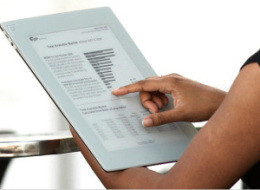
If Amazon and Barnes and Nobles want people to start reading content on eReader devices, they need to start giving them away for free... with a service contract, much like the cellphone industry.
Most people already understand these types of contracts and will feel like they are embarking on a reading plan and not purchasing a device that will become obsolete in a couple of years. This way readers could bundle content and keep it simple. For example you could sign up for a 24 month plan where you pay $20 a month for the right to download one book a month and two magazines or one book and a subscription to a newspaper. This type of Sales model is proven to work well with cell phones I think it would work even better with eReaders.
Friday, May 22, 2009
Kindles Should be Cheap - Amazon Wasting Time

If Amazon doesn't play its cards right it will be usurped by an open sourced ,dirt cheap, easy to use and wireless e-reader when it comes onto the market. What they need to realize is the the reader is a platform, you want to get as many people on board before you start having competition. By selling the Kindle for $300+ they are losing time to dominate market share. They should be trying to give Kindles away and make their money through paid subscriptions much like a cell phone. Get a free Kindle with paid subscriptions that amount to X dollars a month or X amount of a pre-paid book account.
Monday, March 16, 2009
A Solution to stop the bleeding in the Stock Market: Subsidized Short Loans for Housing
 Joel Robinson for LibertyNewsprint.com
For those who bought home in the past 5 years or have an adjustable loan that will reset sometime in the next 5 years.
In order to stop the precipitous decline in the housing industry government needs to provide subsidized "Short" loans for the difference between what a homeowner can sell there house for and the amount the homeowner actually owes. This loan will provide rates the homeowner could receive on a regular home equity loan for up to $100,000
This will allow homeowners to reevaluate their financial positions to more fiscally sound situations if necessary. As it stands now homeowners with good credit have no other choice than to wait until home values increase before they can have the freedom to seek other housing accommodations.
How would this work:
Homeowner A house's current value is $200,000 he owes $250,000.
His payments are about to reset from 4.8% to 6.0%
That’s a payment of $1467 to $1664 and he can't afford it.
Homeowner A sells the house for $200K
Now He Has Options:
Option A:
He gets a loan from the government for $70K at 7% that’s $465 a month.
He finds a smaller place for sale at $150,000 puts 20% down from the government loan.
He gets a mortgage for $130,000 at 6.5% and pays $839 a month.
Now Homeowner A is paying $1,304 a month on a mortgage the will not reset. That’s a saving of $163 a month in the mortgage payments.
Option B:
Continue to pay off the government loan of $50K and find a place to rent.
That’s $333 a month plus rent he can afford to rent an apartment for $1,134
The Benefits of Government Subsidized "Short" loan?
This will allow homeowners to pay back the shortfall without damaging their credit.
Also, by stabilizing hundreds of thousands of homeowners the economy will benefit.
As it stands now homeowners have no viable options if they need to sell their homes, only options that only will exasperate the decline in the overall economy.
This is the only way to:
- Stop the decline of housing prices
- Extend more help to a greater amount of homeowners.
- Keeps the homeowner from transferring debt to government and lenders.
- Stop giving money to the banks
- Free up the housing market for people who can actually afford a mortgage
~LibertyNewsprint.com
Monday, February 23, 2009
California's Ever Rising Budget

In ten years California's Budget has almost doubled. Revenue has rarely been a problem with the Calfornia Budget its always spending.
Thursday, February 5, 2009
Economic Recovery Plan: Oars For A Sinking Ship

Watching the debate in the Senate of the current "Economic Recovery Plan" being considered is like watching a bunch of confused sailors on a sinking boat. There is a gaping hole in the side of the hull and some of the sailors are saying "Quick we need more oars so that we can row ashore!" Others are saying "We need to raise the sails to catch more wind!", a majority are saying "We need to make more life boats so that we can abandon ship!" When what they should be doing is trying to repair the hole that is sinking the ship!
In my opinion that canon ball is the housing problem which created the hole and continues to let in water to sink the ship! Repair the hull of the ship and it will continue to float!
What we need is the Captain of the ship, President Obama, to focus the sailors on the real problem. If he fails to do this, I'm sorry to say, that this Captain will go down with the Ship before he even started to sail.
Wednesday, December 10, 2008
NY Times Copies The Feedjournal Application


In an article posted at itbusiness.ca they wrote:
Clearly, in the New York times "looking" for new software the R&D group must have run across the Made in Express award winning Feedjournal by Mr. Martinsson. With the resources that the New York Times as at its disposal and its desperate search to find an online platform solution that can be personalized and monetized to fit into today's consumers lifestyle, it appears that they appropriated Jonas's idea. Here at Liberty Newsprint we are wondering if Adobe will open up the Adobe AIR so that independent programmers like Mr. Martinsson can also customize it to create useful applications.The New York Times Company's tryst with the "news reader" started with its R&D group investigating various kinds of products and services its audience would likely want moving forward.
"We're always looking for the right hardware and software that [offer] audiences…the best possible user experience," said Zimbalist.
This quest, he said, led the company to work with Adobe to create an advanced news reader application that "properly renders articles and media content as they were intended, regardless of what size of display or what platform the user is on."
Zimbalist demoed some of the compelling features of the news reader app for the International Herald Tribune (which is the global edition of the New York Times).
The application – built on top of Adobe AIR 1.5 – brings readers "today's paper" by caching the latest feeds from the New York Times Web site.
These are presented so you can read can the news online or offline (as Zimbalist said he did on his flight over from New York to San Francisco).
At the top of the reader are displayed all the latest headlines –pulled every few minutes from the New York Times Web site, when readers are online
See the Video:


 Posts
Posts

